I heard North Korea from my backyard in Kansas City
*A $90 portable radio, a loop antenna in a tree, and the strangest thing to ever interrupt a summer morning on the patio.*
By The Long Frequency · July 2026 · 7 min read
At 8:00 in the morning, Central time, on a beautiful summer Tuesday in Kansas City, a military march came out of the static.
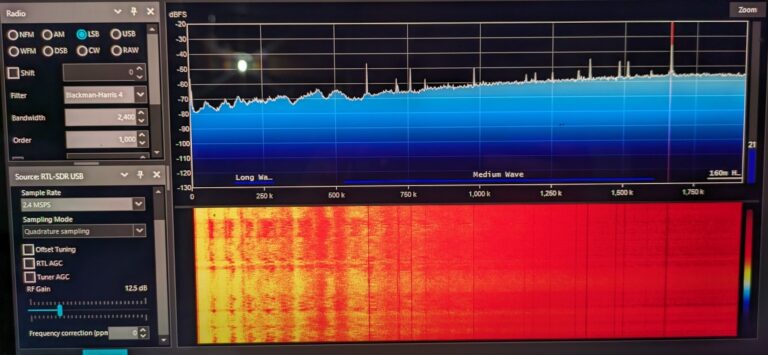
I was sitting on my back patio with an espresso, headphones on, staring at the little display of a Tecsun PL-330 tuned to 11710 kHz. For the previous half hour there had been nothing there. Just the hiss and wash of an empty frequency, the sound the planet makes when nobody is talking on it. And then, like clockwork, at the top of the hour: music chimes. Faint, wavering, buried in noise, but unmistakably music, the kind you’d hear at a military parade. Horns and drums marching in formation.
Then a voice, formal and clear underneath the static:
“This is the Voice of Korea.”
Pyongyang. On my patio. In Kansas City.
## Why I was even trying
If you’ve read [what Art Bell taught me about finding your frequency](https://thelongfrequency.com/what-art-bell-taught-me-about-finding-your-frequency/), you already know I’m drawn to the idea that the air around us is full of voices, and that with the right piece of equipment you can reach out and catch one. Most of my listening happens through an [RTL-SDR dongle](https://thelongfrequency.com/the-beginners-guide-to-rtl-sdr-what-you-can-hear-for-40-and-a-usb-dongle/) and a laptop. But there’s a particular romance to shortwave, the old long haul bands where signals bounce off the upper atmosphere and come down thousands of miles from where they started. And there is no stranger catch on shortwave than Voice of Korea.
Voice of Korea is North Korea’s official international broadcaster, the external voice of the most closed country on Earth. They run high powered transmitters aimed at North America, broadcasting in English on a rigid schedule. Almost nobody inside North Korea can hear the outside world. But the outside world can hear them, if you’re willing to get up early and sit with the static.
I’d been meaning to try for weeks. The gear sat ready. The mornings kept not happening. If you’re waiting for the perfect morning to try something like this, let me report from the other side: the perfect morning is just the one where you actually go outside.
## The setup
The rig is honest hobby grade, nothing exotic:
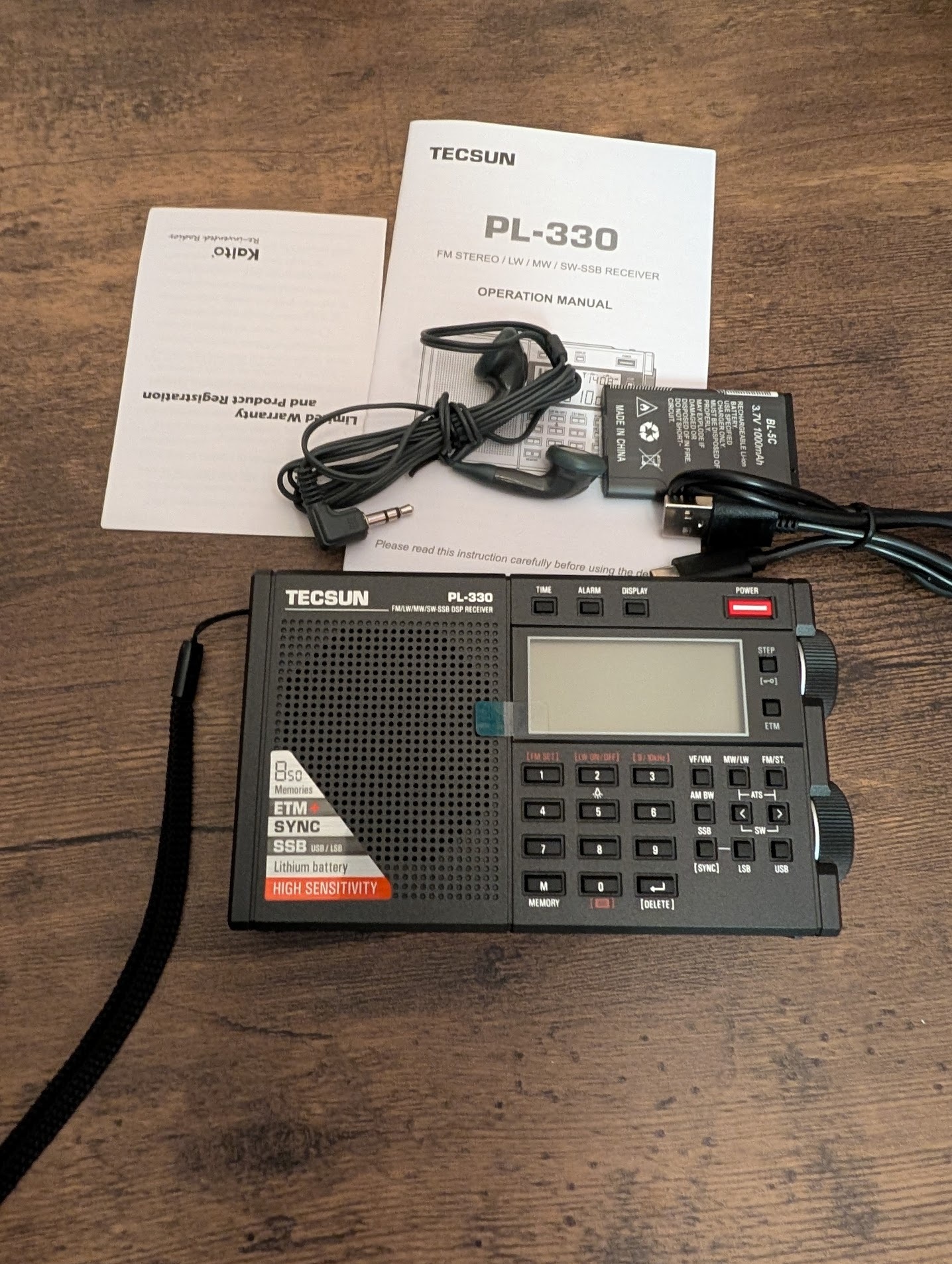
– A **Tecsun PL-330**, a portable world band receiver about the size of a paperback. It does AM, FM, longwave, shortwave, and single sideband, and it’s the radio I’d hand anyone who wanted to try this. [Here’s the one I use.](https://amzn.to/4xo3jFh)
– An **MLA-30+ active loop antenna**, a wire hoop with a small amplifier that excels at pulling weak signals out of electrically noisy neighborhoods, which in 2026 means every neighborhood. [This is mine.](https://amzn.to/3QvJxXA)
– A length of PVC pipe as a mast, because the loop needs a non-metal support, and a tree in the backyard willing to hold the whole contraption up.
I mounted the loop with its edges facing northwest and southeast. That’s not decorative: a magnetic loop hears through its edges and is nearly deaf out of its flat faces, and the signal from Korea comes over the pole from the northwest. Everything ran through a power filter to knock down household electrical interference. I set it all up the night before, plugs staged, so that at 7:30 in the morning I could carry out an espresso, connect two cables, and not have to think.
I’m sure the neighbors wonder what the wire hoop on a plumbing pipe in my tree is for. I consider this part of the charm.
## The catch
Voice of Korea’s English service to North America runs on a fixed schedule, and the morning slot starts at 13:00 UTC, which is 8:00 AM Central. The frequencies to know are 9435 kHz and 11710 kHz. I picked 11710 and waited.
Here’s the part nobody tells you about shortwave listening: most of it is listening to nothing. From 7:30 to 8:00 that frequency was pure static, and you start to wonder if the antenna’s wrong, if the propagation’s wrong, if the whole idea is wrong. Then the top of the hour arrived and the broadcast switched on, right on schedule, like a lighthouse lamp lighting.
The sign-on music came first, that parade ground march fighting through the noise. The official sign on is the chimes of a patriotic anthem, and even barely above the static there was no mistaking the character of it. Then the announcement, that formal female voice, slightly dated English, absolutely clear about where it was coming from.
I want to be honest about the signal quality, because this matters if you try it yourself: it was weak. It faded and swelled the way long-haul shortwave does, the ionosphere breathing between Pyongyang and Kansas. This was not armchair listening. It was leaning in listening, the kind where your brain does half the demodulating. And it was still one of the most quietly astonishing things I’ve done with ninety dollars of radio equipment.
I sat there with my espresso going cold, listening to a signal that had left a transmitter on the other side of the planet, skipped off the upper atmosphere across the Pacific, and come down in my backyard.
At 8:25 I took the headphones off and went inside for my daily standup meeting on Teams.
I don’t know how to describe the whiplash of that transition except to say that both things are true at once: we live in a world where the strangest station on Earth can reach a patio in Kansas City, and a world where you then have to go talk about sprint tickets. I recommend experiencing them back to back at least once.
## How to try this yourself
You need three things: the gear above, the schedule, and patience.
**Frequencies:** 9435 kHz and 11710 kHz for the English service to North America. If 11710 sounds off, check 11735, where the signal occasionally drifts.
**Times:** the morning English broadcast runs 8:00 to 9:00 AM Central (13:00 to 14:00 UTC), with a second slot from 10:00 to 11:00 AM Central. The morning window was my catch, and it roughly lines up with greyline propagation, the twilight-boundary conditions that give signals crossing from Asia a boost.
**Technique:** put the loop’s edges toward the northwest. Start listening a few minutes before the hour so you hear the moment it switches on. If the signal is rough, narrow the radio’s bandwidth filter to 2.5 or even 1.5 kHz; the audio gets muffled but the voice climbs out of the noise.
**Expectations:** it took me weeks of intending and one morning of doing, and the catch was faint. Conditions change daily with the ionosphere. A frequency that barely whispers today can boom next week with nothing changed on your end. That’s not a flaw in the hobby. That is the hobby.
My own signal has plenty of room to improve, and that’s the next project: cleaner power, better placement, hunting down the noise sources in my own house. That journey is an article of its own, coming soon.
There’s a lot up there. Go find it.
*This article contains affiliate links. If you purchase through them I earn a small commission at no extra cost to you.*