What nobody tells you about your first trip to Cebu
What nobody tells you about your first trip to Cebu
Everyone said the Philippines was too dangerous to visit. I rented an apartment for a month and went anyway. Here’s what actually happened.
By The Long Frequency · April 2026 · 10 min read
When I told people I was going to the Philippines for a month the reactions were pretty consistent. Too dangerous. Too far. Why would you go there alone? I heard every version of that conversation more times than I can count.
I went anyway. I rented an apartment in Cebu for a month, my first international trip ever and I haven’t been the same since.
This is what they don’t put in the travel guides.
Landing at Mactan: welcome to another planet
The apartment owners were kind enough to send their assistants to meet me at Mactan-Cebu International Airport. I didn’t find them for a good thirty minutes. They weren’t holding their sign high enough in the crowd. That crowd, by the way, is something you need to mentally prepare for. Mactan arrivals is organized chaos at a volume and density that hits you like a wall after a twenty-plus hour journey from the US.
I eventually found them, got in the van, and within about four minutes of leaving the airport I felt I had landed on another planet.
Horns honking constantly, not in anger, just as communication. The way people use turn signals back home. A smell of smoke in the air that I still can’t fully describe, part exhaust, part something burning somewhere, part street food. Stray dogs weaving through traffic like they owned the road. And then, right next to one of the busiest streets I had ever seen in my life, a man casually relieving himself against a wall like it was the most natural thing in the world.
I laugh about that now. In the moment I just stared out the van window thinking: okay. Different rules here.
The first night: going hungry
By the time I got to the apartment, showered, and started thinking about food, it was late. Too late, I discovered, to get money from the ATM or at least the one I could find was out of service. I hadn’t thought to get pesos before I landed.
I went to bed hungry my first night in Cebu.
Learn from that. Whatever else you pack, bring some local currency from home or exchange at the airport before you leave arrivals. The ATM situation outside major malls and tourist areas can be unpredictable, machines run out of money, cards get declined, and you do not want to be standing on a dark street in an unfamiliar city at 10pm with no cash and no idea where the nearest open restaurant is.
Practical note for first-timers Get pesos before you land, or exchange at the Mactan airport arrivals hall before you exit. Don’t count on finding a working ATM immediately. Having 2,000–3,000 pesos on arrival covers your first day comfortably.
Joe
On my first day out I was walking toward Marina Mall when a group of kids called out to me. “Hey Joe!” They were grinning. I had no idea what it meant.
I had to ask someone. Joe is a Filipino term for American men, dating back to the US military presence in the Philippines. It’s not always meant as a compliment depending on context, but from these kids it was pure curiosity and delight. They’d spotted a foreigner and they were delighted about it. There was no malice in it whatsoever.
You will get looked at in Cebu. Especially outside the tourist areas. Most of the time it’s genuine curiosity. Filipinos are, on the whole, extraordinarily warm toward visitors particularly Americans. Partly because of shared history and partly just because warmth seems to be genuinely baked into the culture in a way that’s hard to explain until you’ve experienced it.
The taxi situation
This was before Grab existed in Cebu. Which meant negotiating with taxi drivers, and roughly every other one tried to overcharge me.
My meter is broken. The traffic is bad so it costs more. Gasoline is expensive. I heard every excuse there was. It made me genuinely upset for a while, that was until I watched them do the exact same thing to fellow Filipinos. That reframed it completely. It wasn’t about me being foreign. It was just opportunism, applied equally.
The fix now is simple: use Grab. It’s the Southeast Asian equivalent of Uber, it’s reliable, the prices are set before you get in the car, and it operates throughout Cebu City. If you’re visiting, download it before you land.
For the drivers who didn’t try to rip me off, I always tipped a dollar or two. The equivalent of almost nothing to me, genuinely meaningful to them, and it felt like the right thing to do.
The karinderya across the street
My first real meal in Cebu came from a karinderya, a small informal eatery run by a nice couple across the street from my apartment. A karinderya is basically someone’s kitchen opened to the public, with whatever they cooked that day sitting in pots behind a glass case. You point at what you want. It’s cheap, it’s real Filipino food, and it is almost always delicious.
A group of nursing students ended up eating at the table next to me. I could feel I was being watched. There was giggling. Finally one of them worked up the courage to come over and show me how to use my fork and spoon together, the Filipino way of eating, where the spoon is the primary utensil and the fork is used to push food onto it.
Nobody was laughing at me. They were delighted to help. That interaction was a stranger’s genuine, laughing kindness toward someone who clearly had no idea what he was doing. It’s one of my clearest memories from that whole trip.
“That interaction was a stranger’s genuine, laughing kindness toward someone who clearly had no idea what he was doing. It’s one of my clearest memories from that whole trip.”
Santo Niño, Magellan’s Cross, and the Taoist Temple
The Basilica Minore del Santo Niño is one of the oldest Roman Catholic churches in the Philippines and it holds the Santo Niño de Cebú. A statue of the infant Jesus that has been venerated in the Philippines since Magellan’s expedition in 1521. Someone told me how to approach the glass it’s kept behind and kiss it for a blessing. The line around that church was unlike anything I’d ever seen outside of a major sporting event. Many people are there for deeply personal reasons and hold their hands on it or a handkerchief against it.
Nearby is Magellan’s Cross, the Christian cross that Ferdinand Magellan planted when he arrived in 1521 marking the beginning of Spain’s colonization of the Philippines. It sits in a small chapel and is genuinely moving if you think about what it represents and how long it’s been there.
The Taoist Temple up in Beverly Hills, Cebu’s upscale residential area is something else entirely. The views over the city are worth the trip alone. It’s colorful, elaborate, and completely different from the Catholic architecture that dominates Cebu. The Philippines contains multitudes.
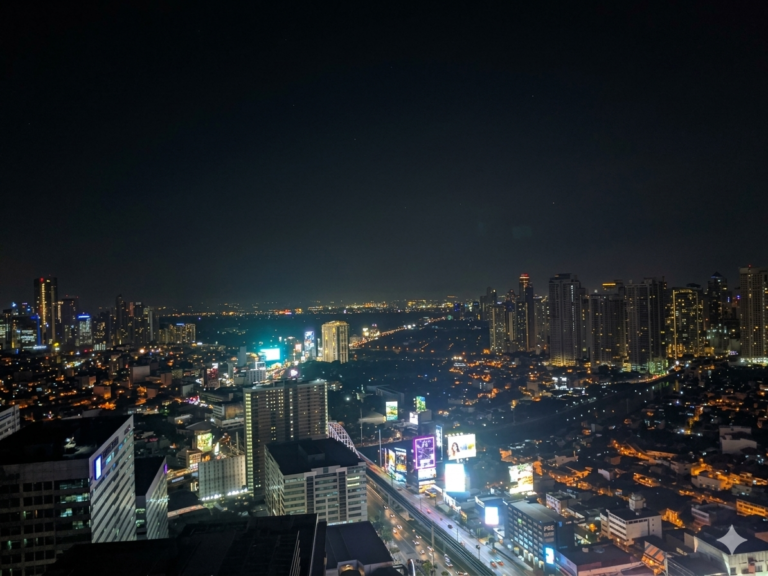
Tops Busay, the overlook above the city, is where you go at night to see Cebu spread out below you in lights. Go at dusk. Stay for the dark. It’s one of those views that makes you feel the size of the world.
Bohol, the chocolate hills, and a tarsier
I got on a speed ferry and crossed to Bohol which is the island just east of Cebu for a day trip. The Chocolate Hills are exactly what the photos suggest: hundreds of nearly perfectly conical hills that turn brown in the dry season, covering an area so large you can’t see the edge of them from the viewing platform. They’re genuinely strange and beautiful in a way that photographs don’t quite capture.
I held a tarsier. This was before they informed visitors that is was illegal. Tarsiers are protected and you’re only supposed to observe them in sanctioned sanctuaries without touching them, which is the right call since they’re extraordinarily fragile animals. But I held one, and it looked at me with those enormous eyes, and I understood immediately why people fall in love with the Philippines.
Beer, cockfights, and a witch’s cauldron
I drank beer with some local guys near Gaisano Country Mall and watched cockfighting. Sabong or cockfighting is deeply embedded in Filipino culture in a way that’s jarring if you come from a place where it’s illegal and associated only with cruelty. Context doesn’t make it easy to watch, but understanding it as a genuine cultural tradition rather than something hidden and shameful shifts how you see it.
I volunteered at a public hospital. I helped make lunch for school kids in a giant pot that I can only describe as something a witch would own. It was enormous, blackened, over an open flame, being stirred by women who clearly knew exactly what they were doing and found my presence mildly amusing. I handed out soap, shampoo and deodorant at a women’s prison.
None of those things are in a travel guide. All of them are real Cebu.
The bus to Malabuyoc and the boy in the coconut tree
I traveled by bus to a small town called Malabuyoc, near the famous Kawasan Falls in the south of Cebu. No air conditioning. The kind of heat that makes you reconsider every decision that led you to this moment.
I stayed deep up the mountain — a good 45-minute hike or a short dirt bike ride from the nearest road. One night, while I was falling asleep, I became aware of movement outside the window. A little boy from the province had gotten curious about the foreigner staying up the mountain. He had climbed a coconut tree to try and peek through my window.
I don’t know how long he’d been up there.
On the bus back to Cebu I was dying from the heat and humidity. I rolled my window down. One woman scowled at me. Everyone else had their windows up and I couldn’t figure out why, it had to be 95 degrees in that bus.
It turned out it was a holiday celebrating St. John the Baptist. In Cebu, kids line up along the highway and throw water balloons at passing cars and buses as part of the celebration. I did not know this.
As fate would have it, a water balloon came through my open window and found someone several seats behind me.
I closed my window after that.
Was it dangerous?
Honestly, yes and no. There are parts of Cebu City that are not safe to walk through, and this applies to Filipinos as much as to foreigners. Petty crime exists. Pickpocketing happens. People will size you up on the street sometimes, and your instincts about when to keep walking are worth trusting.
But the version of the Philippines that well meaning people warned me about, the cartoonishly dangerous place where bad things happen to naive Americans, that’s not Cebu. What Cebu actually is, is a complicated, layered, beautiful, occasionally overwhelming city full of people who are, on balance, extraordinarily kind to strangers.
The month I spent there was one of the most alive I have ever felt. Every day was interesting. Every interaction taught me something. I came home different and I’ve been going back to the Philippines ever since.
If people are telling you the Philippines is too dangerous to visit I understand why they’re saying it. And I’m telling you from experience that they’re not entirely right.
Go. Get your pesos before you land. Learn to use a spoon with a fork. Let a nursing student laugh at you. Say a prayer at Santo Niño.
You’ll figure out the rest.