What nobody tells you about Hyderabad
Hyderabad is a city that mixes tradition with modernization and does it with grace.
By The Long Frequency · May 2026 · 10 min read
I want to tell you about a man named Dillip.
He works the chai station at the Radisson Blu in Hyderabad. Quiet, warm, attentive in a way that felt genuinely personal rather than professionally performed. By the second morning he had figured out my coworker and I’s routine without being asked. By the third morning our chai was waiting for us at his station before we sat down.
His favorite to make us was Iranian style with strong ginger, fresh mint leaves floating on top, served in small glasses that warmed your hands while the Hyderabad morning moved outside the window. After every cup he’d come by and ask if it tasted good. He’d recommend which biscuits paired best with each variety. He introduced us to drinks we didn’t know to ask for.
I’ve had tea in a lot of places. I’ve never had a person make tea for me the way Dillip did, like it mattered, like getting it right for a stranger from the U.S was worth his full attention.
I wish I could bring him back with us for morning chai at the office.
That’s Hyderabad. That’s what nobody tells you before you go.
Landing: armed police and comfortable heat
I arrived in the evening which turned out to be the best possible time. The air was hot but not punishing, a warm comfortable heat that felt almost welcoming after the recycled cold air of the airplane cabin. I walked outside the terminal into a wall of taxi drivers offering rides, horns already blaring, armed police moving through the crowd with expressions that suggested they had seen everything and were prepared for more.
The chaos was immediate. So was the warmth underneath it.
The office
Our office was on the second floor of a three story building. The elevator was a narrow thing that reminded me immediately of the old lifts I’d ridden in Rome years ago. Just enough room for three people if nobody moved their elbows. It had that same slightly uncertain quality, the sense that it had been working reliably for decades and intended to keep doing so.
The office itself was open and basic. A main room with tables where teammates chose a spot each morning and placed their laptop. No assigned desks, no dual monitor setups, no ergonomic chairs. Two smaller rooms for meetings and equipment storage. And in one corner, a dedicated prayer rug and space, quiet and considered, part of the room the way a window is part of a room.
No frills. Serious work being done. I respected it immediately.
Kabul Darbar and the motorcycle ride there
Getting to dinner the first night involved climbing onto the back of a coworker’s motorcycle.
I want to be honest about the traffic in Hyderabad. It makes Manila look organized. Cars, motorcycles, scooters, buses, tuk tuks and all of them occupying the same space according to a logic that isn’t immediately apparent to someone from a city where lanes are suggestions people mostly follow. We wove through all of it at a pace that required a level of trust I had not fully negotiated with myself before getting on.
My coworker joked later at dinner about how tightly I’d held his shoulders the entire ride.
I told him I just didn’t want him to get cold.
Kabul Darbar is up a flight of stairs. You take your shoes off at the top and step up onto a carpeted platform in deep red, pillows placed along every wall for when you’ve eaten enough that sitting upright requires assistance. You sit cross legged and eat from shared plates. The servers take it as a personal matter if too much time passes between dishes arriving.
We started with awkward small talk. The particular discomfort of colleagues who work together remotely suddenly sharing physical space and food. Then the food arrived and the conversation found its footing. Shared plates do something to a conversation. The lamb meat that fell off the bone helped.
The call to prayer came through the window while we ate. I took it in the way you take in a film score when it’s working. Not consciously, just as part of the atmosphere of the moment.
Zafrani Tea and the best biscuit dunking of my life
A few blocks from Kabul Darbar, down streets that were somehow even busier after dark, is a chai stall called Zafrani Tea. Describing it as a stall undersellsit though. The entire area around it was packed with motorcycles, people, outdoor tables, the particular organized chaos of a place that has been consistently excellent for long enough that everyone knows where it is.
The tea was complex the way good food is complex. Flavors that introduced themselves one at a time rather than arriving all at once. Sweet, with something underneath the sweetness that I couldn’t name. The biscuits they served alongside it were slightly salty, designed specifically for dunking, and the contrast between the sweet tea and the salt was one of those small perfect things you find when you let a place tell you what to eat instead of choosing for yourself.
My coworkers and I collected some curious looks from the other patrons. A few foreigners standing at outdoor tables dunking biscuits in chai at a local spot in Hyderabad at night. We didn’t mind. The tea was worth the stares.
Charminar and the old city
I have been in crowded places. I have walked through Cebu City markets and Manila streets and Singapore on a weekend morning. None of them prepared me for the area around Charminar on a busy Sunday afternoon.
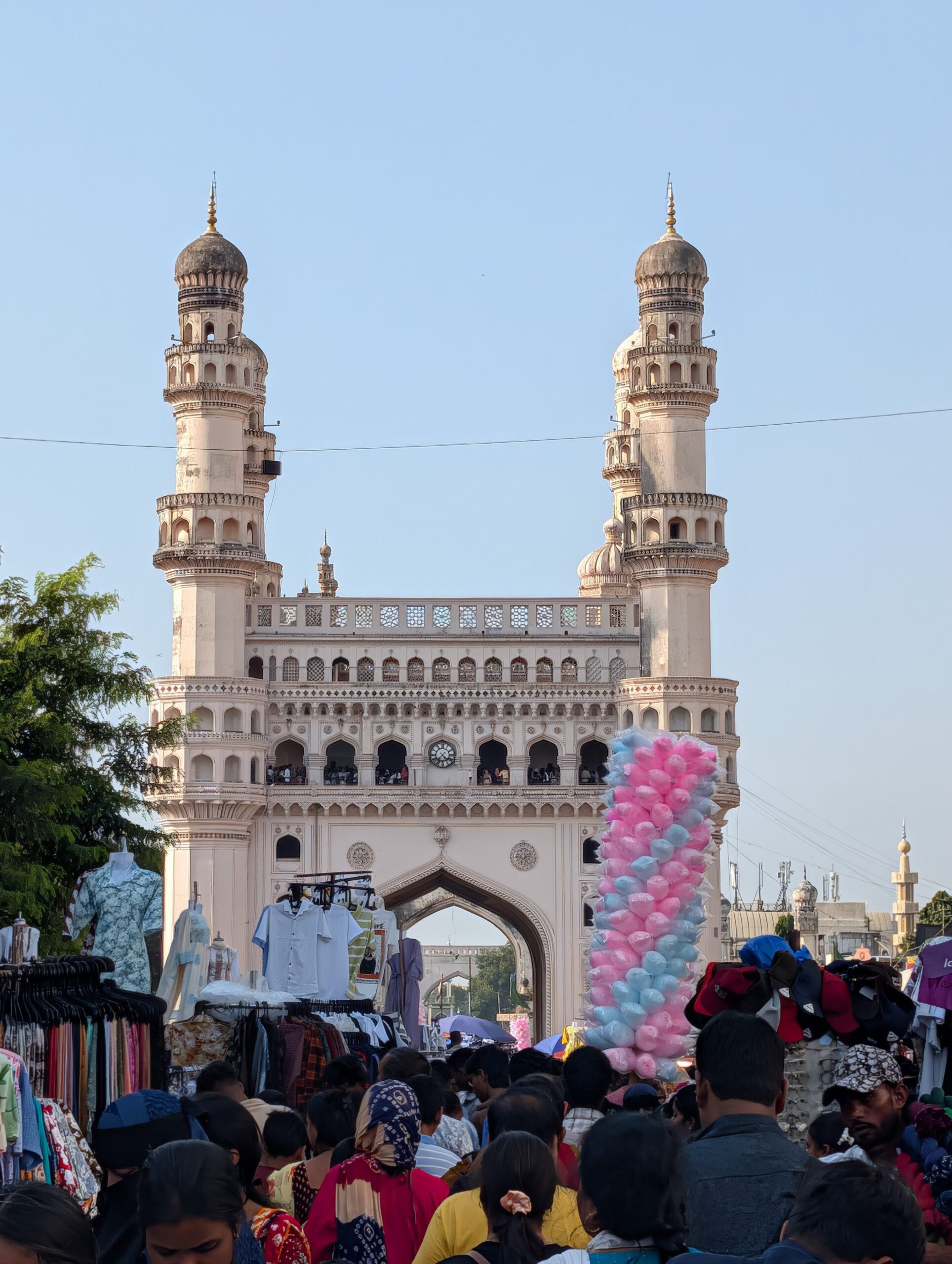
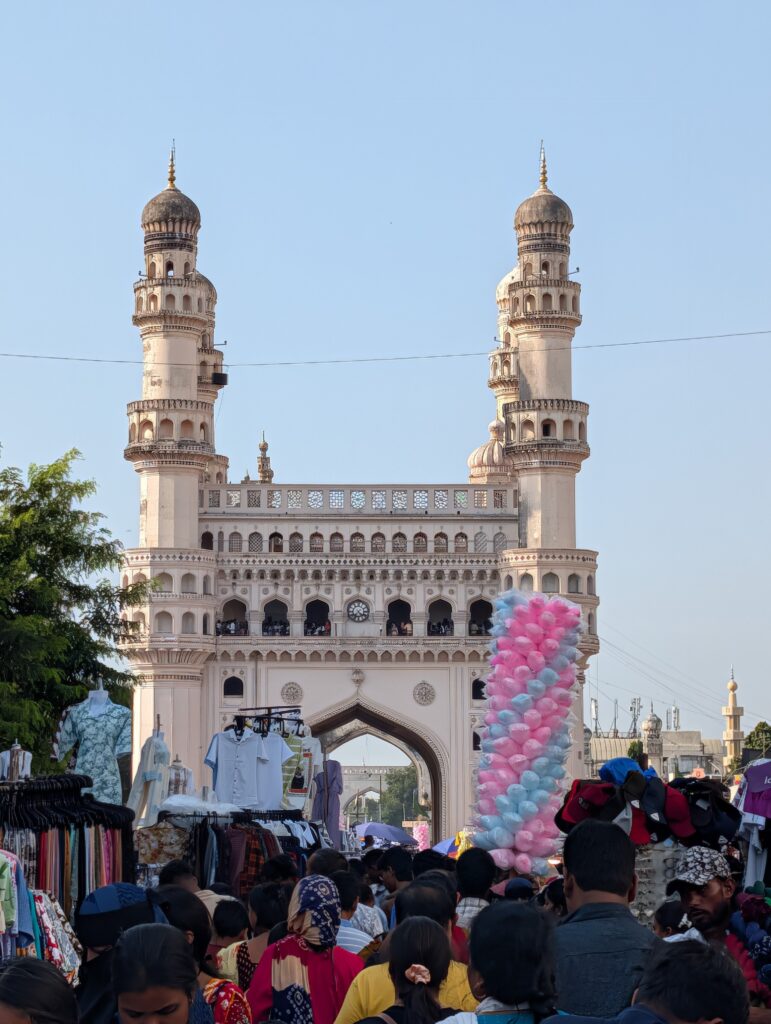
Charminar is a 400 year old mosque and monument at the center of the old city. Four minarets rising above a market that has been operating around its base for centuries. Warnings played on speakers about pickpockets. A vendor had constructed a tower of cotton candy in pink and blue directly in front of one of the arches, the kind of image that makes you stop walking because your brain needs a moment to process it. Ancient stone and spun sugar. Both completely serious about their purpose.
We took tourist photos dressed in old style Indian royal clothing, the kind of photographs you take specifically because they’re ridiculous and you’ll be glad you have them. We toured Chowmahalla Palace, the former seat of the Nizams who were the Muslim rulers governing Hyderabad as an independent state until 1948. Their car collection. Their furniture. Their weapons. Five hundred years of power and refinement preserved in rooms you walk through with other tourists.
Somewhere in the crowd at the monument I kept running into the same little boy. A local kid about 10 years of age who called us “English” rather than American. We couldn’t share a language beyond smiles and handshakes. Every time we crossed paths in that impossible crowd he grinned and put his hand out and said “English”. I shook it every time.
Kaju paan and cologne
Near the office there are cologne and perfume shops that make custom versions of expensive brands. On my last day I went in and came out with several bottles at five to seven dollars each. The two young men working there asked if I would appear in an Instagram video giving a review.
I am not someone who does this kind of thing at home. I said yes.
Somewhere on the internet there is a video of a slightly shy man from the U.S giving a glowing review to a cologne shop in Hyderabad. They asked where I was from and how was my experience. I told them honestly. They were delighted. I appreciated their hustle in a way that felt specific to this city. The entrepreneurial energy of a place that has been building things for a very long time and intends to keep going with each new generation.
Also near the office: a vendor selling kaju paan. It’s a sweet dessert made from cashew paste and betel leaf filled with things I couldn’t identify and didn’t need to. The first taste was sweet and simple. Then it kept going. Then it kept going after that. Ten flavors minimum, each one arriving just as the previous one was finishing, like a Willy Wonka candy designed by someone who understood that the best experiences reveal themselves gradually.
I stood on the street eating it and thought about how many things in Hyderabad worked exactly like that.
The rooftop
Every evening I went to the roof of our office building.
I didn’t plan to make it a ritual. The first evening I went up to see the view and stayed longer than I intended. The second evening I went back. By the third evening I understood I was going to keep going back until I left.
The sun sets over Hyderabad in shades of orange that the pollution and heat haze turn into something almost cinematic. The rooftop traffic photo I took one evening looked like a still from a film nobody had made yet.
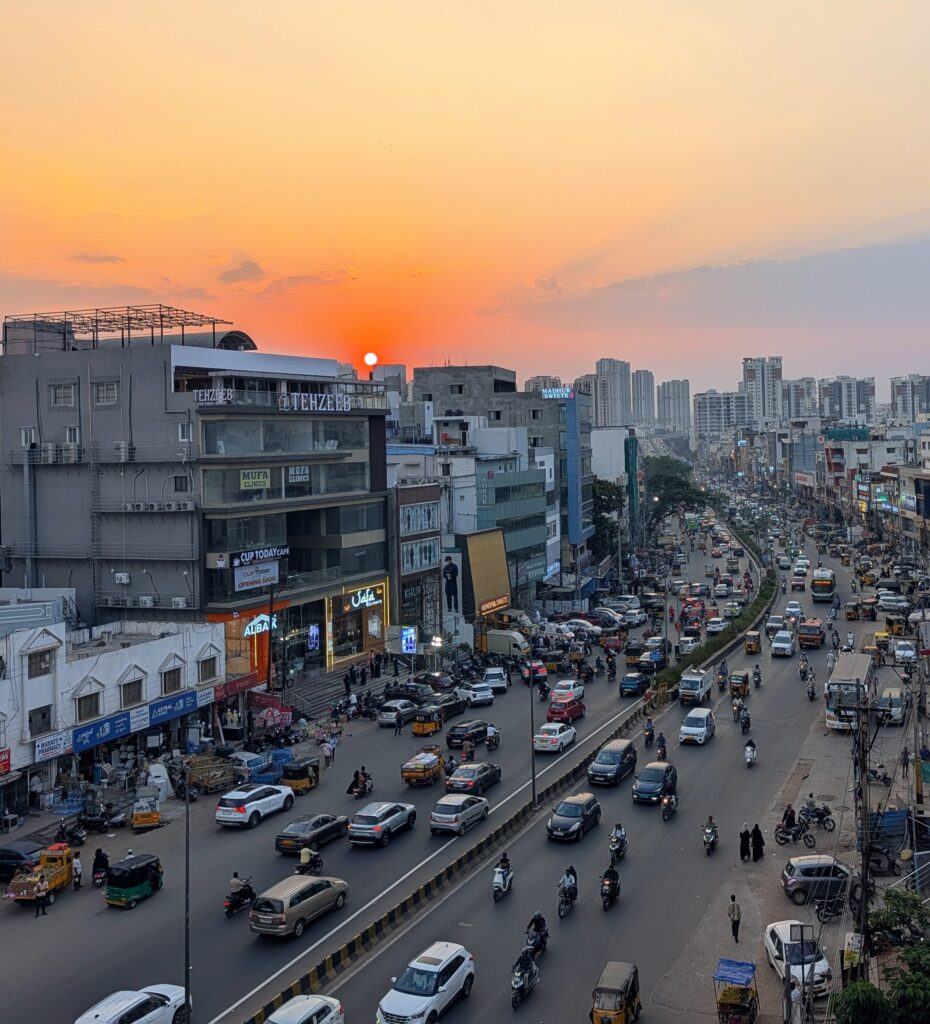
Below the building the street ran in both directions into the city, and if you stood at the right angle you could see the transition happen in real time: fruit stall sellers and women in hijabs in the foreground, new high rises going up along the horizon as far as you could see.
Old ways. New buildings. Both completely real. Neither apologizing for the other.
And then the call to prayer would start. It comes through speakers mounted on minarets across the city, the kind of speakers we’d use at home for tornado warnings, reaching every corner of every neighborhood with something that had been said in this city five times a day for four hundred years.
I’m not Muslim. I don’t share the faith. But standing on that rooftop in the cooling evening air listening to the adhan rise above the traffic noise while the sun dropped behind the skyline. I understood why people find their way back to things that are older than they are.
I made it a ritual because it deserved to be one.
The fitting room
In a mall called City Center I was trying on t-shirts when a young man who worked in the fitting room approached me with the particular careful politeness of someone about to ask something they weren’t sure was allowed.
He asked where I was from and I obliged.
He told me he was a big fan of Americans. That it was his dream to live and work in the United States someday. He asked what jobs were in demand. I told him Data Science was a strong path. I gave him what encouragement I could. That the dream was a real one, that it was worth working toward, that hard work in the right direction tends to eventually arrive somewhere.
I hope I was right about that and I hope one day I somehow run into him living and working his dream.
What Hyderabad actually is
I went to Hyderabad for work. I came back having eaten the best biryani of my life at a restaurant called Shadab. Smoky first, then layers of spice, then cool raita to bring you back, washed down with Thumbs Up, which is India’s own cola and has been refusing to lose to Coca-Cola for decades. I came back having ridden motorcycles through traffic that operates by rules I never fully decoded. Having drunk chai made by a man named Dillip who made it feel like a ceremony worth observing. Having stood on a rooftop every evening listening to something four hundred years old rise above a city building its future at full speed.
Hyderabad is a city that mixes tradition with modernization and does it with grace.
I didn’t expect to love it. I didn’t expect to find myself on a rooftop every evening treating a sunset like something that required my full attention.
But that’s what travel does when you let it. It finds the things you didn’t know you were looking for.
One thing I’d do differently next time: travel with a VPN. India blocks more services than you realize until you hit one. That includes TikTok, certain banking apps, and a few news sites I tried to read from my hotel. I wrote up the full case for traveling with a VPN here, with the SDR and ham radio angle that probably matters more to half of you reading this.
On the flight home my Indian coworkers told me to watch Baahubali on Netflix. I did, somewhere over the ocean, too tired to sleep, the epic battle scenes playing while Hyderabad got smaller behind me.
It was exactly the right homework assignment.
One Comment
Comments are closed.